( 1 ) What were your first Impressions of the project?
When I was invited, I was very intrigued by the project's premise and excited to participate. It included some teamwork elements, but because of its sequential structure, it also reminded me of the Chinese whisperers game or Surrealists' exquisite corpse practices with a twist. I was ninth out of ten artists, so it took a while for my turn, which brought me a bit of anxiety from waiting and not knowing what to expect from the artist before me.
( 2 ) What surprised you?
Beforehand, we were all aware that we might not be using the same programming environments and setups. Fortunately, Juan (the artist who came before me) uses essentially the same programming techniques that I do, with the notable exception that he uses shaders (GLSL) for postproduction of the output. After eliminating this layer, everything became legible. For me, this is not the first time I've realized that most of us write in a simple and comprehensible manner, driven by a goal rather than the technicalities of optimal and compressed code, which I think is a positive because we're artists first and foremost.
( 3 ) What was your creative process?
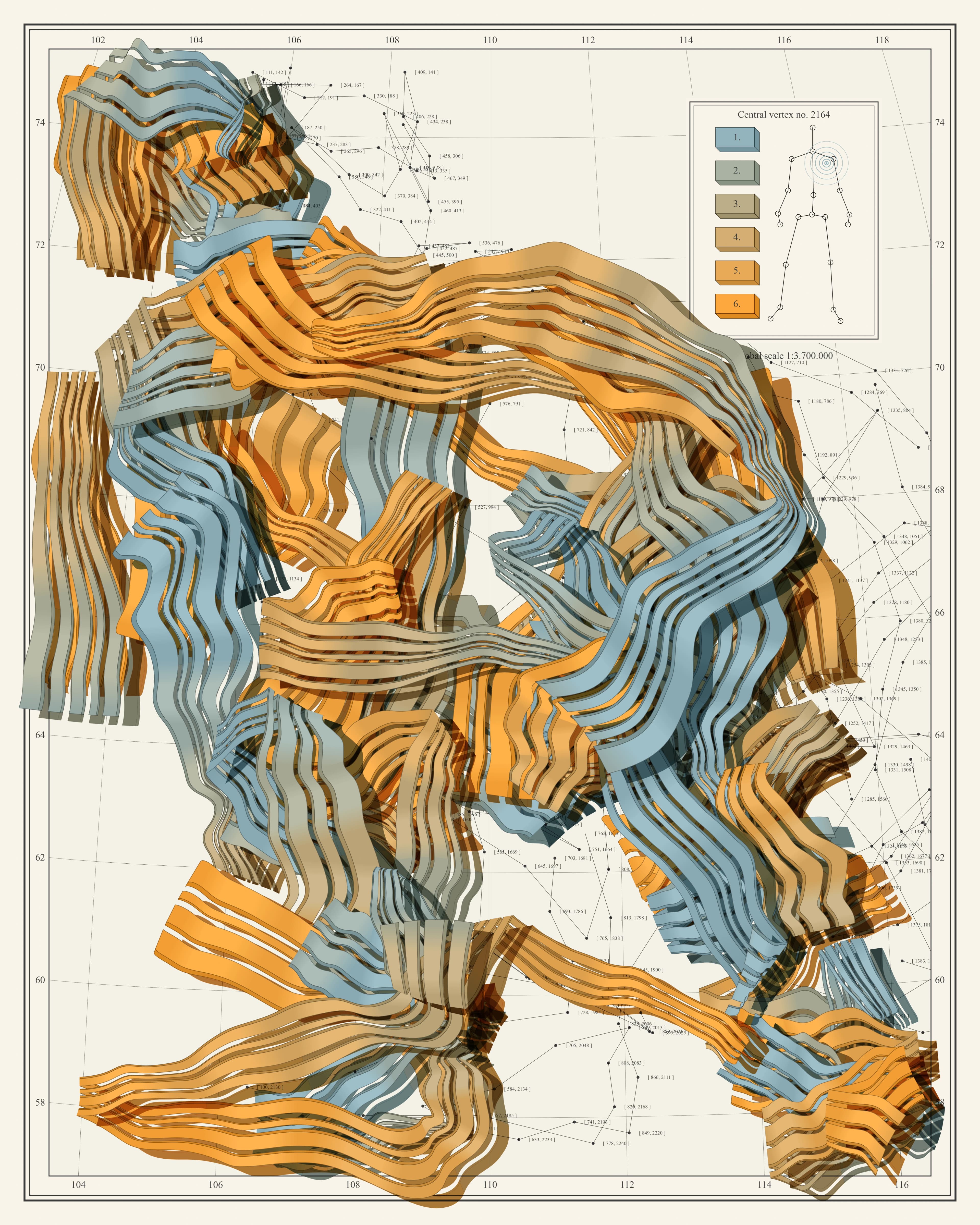
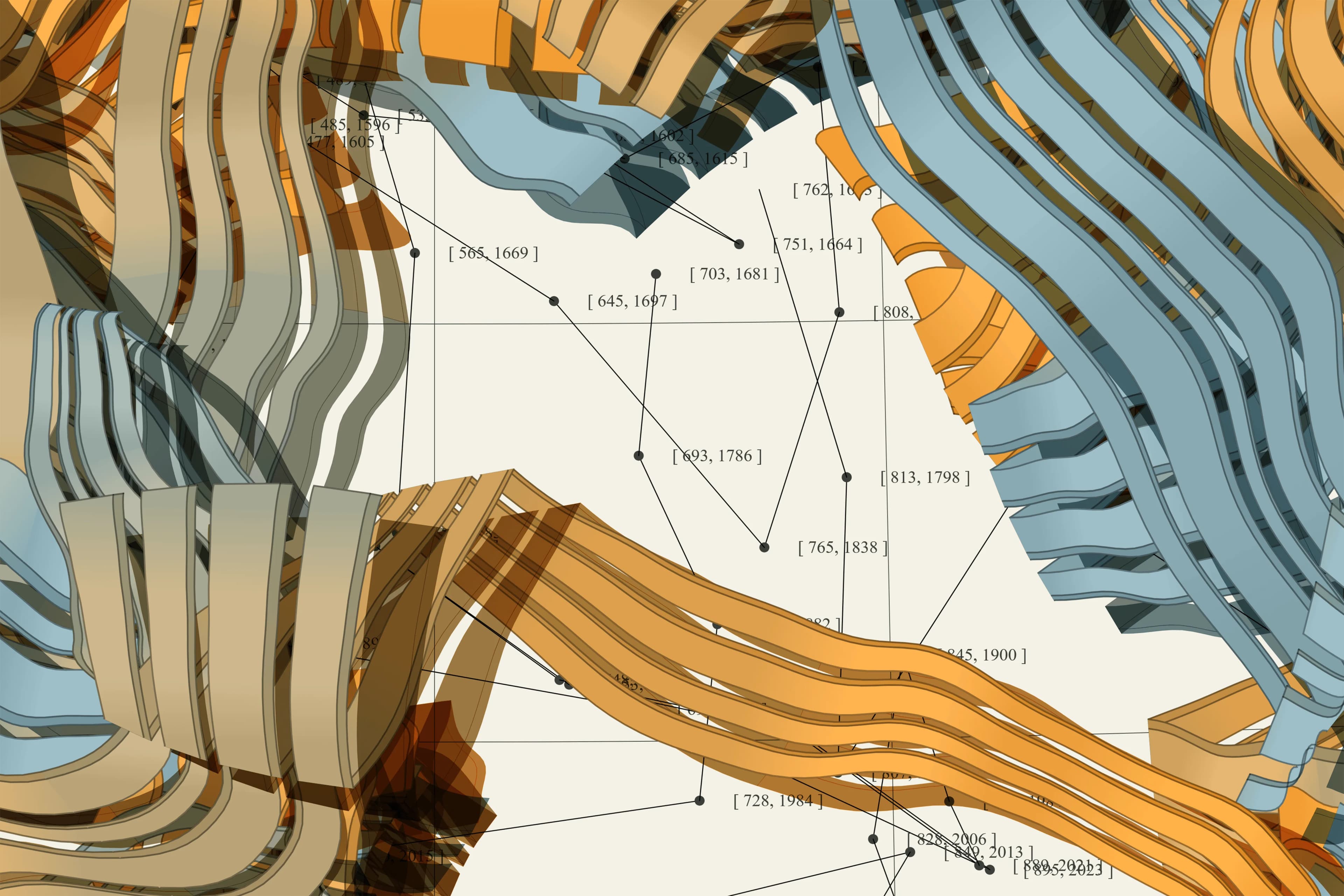
After becoming familiar with Juan’s code, I decided to deconstruct it and spend the first week running a series of quick experiments to determine a possible direction. Having followed his work for years, I knew the first thing I wanted to experiment with was the recognizable 3D models embedded in his pieces. I inspected the objects’ topology in Maya to explore the data I could potentially extract from them. Other experiments involved identifying simple structural patterns, such as radial or cylindrical arrangements of the objects he used, and exploring how these could be combined with my own visual language. By the end of this first week, I realized that the vertex positions from one of the 3D models provided more than enough data that could be interpreted in multiple ways, so I decided to continue developing the work from that point.
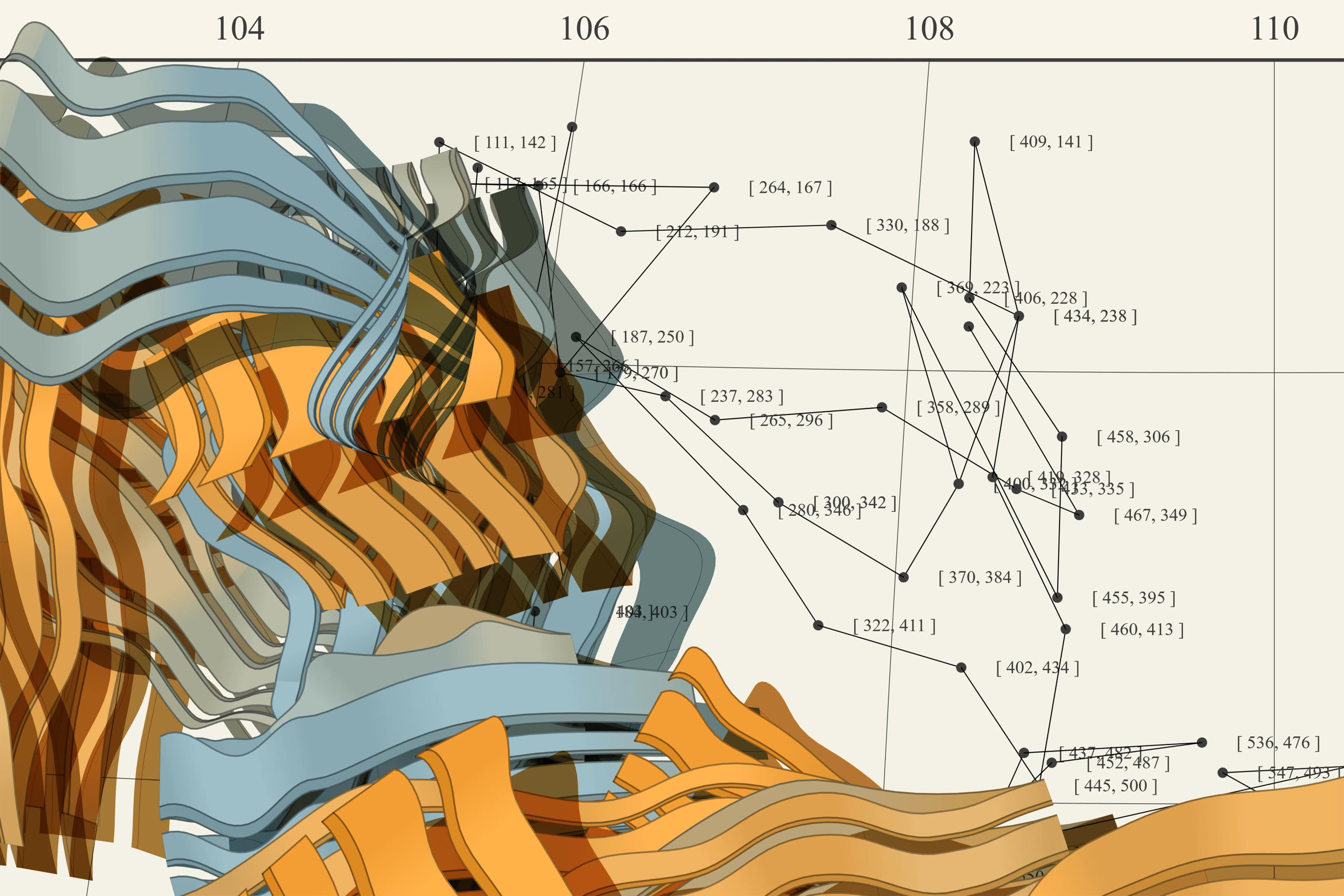
Since I often use random walk as an underlying algorithm in my work, I began exploring different random methods for connecting the vertices’ coordinates of the 3D models into one or more continuous paths. The first approach followed the original vertex order defined by the model’s topology, which produced visually interesting results but occasionally resulted in very long steps alongside many very short ones. I then experimented with two additional strategies: generating continuous paths based on nearest-neighbor algorithm and grouping vertices using convex hull. In the final piece, I combined the inherited vertex arrangement from the original topology with the nearest-neighbor method to construct the final paths.
( 4 ) What did you change and why?
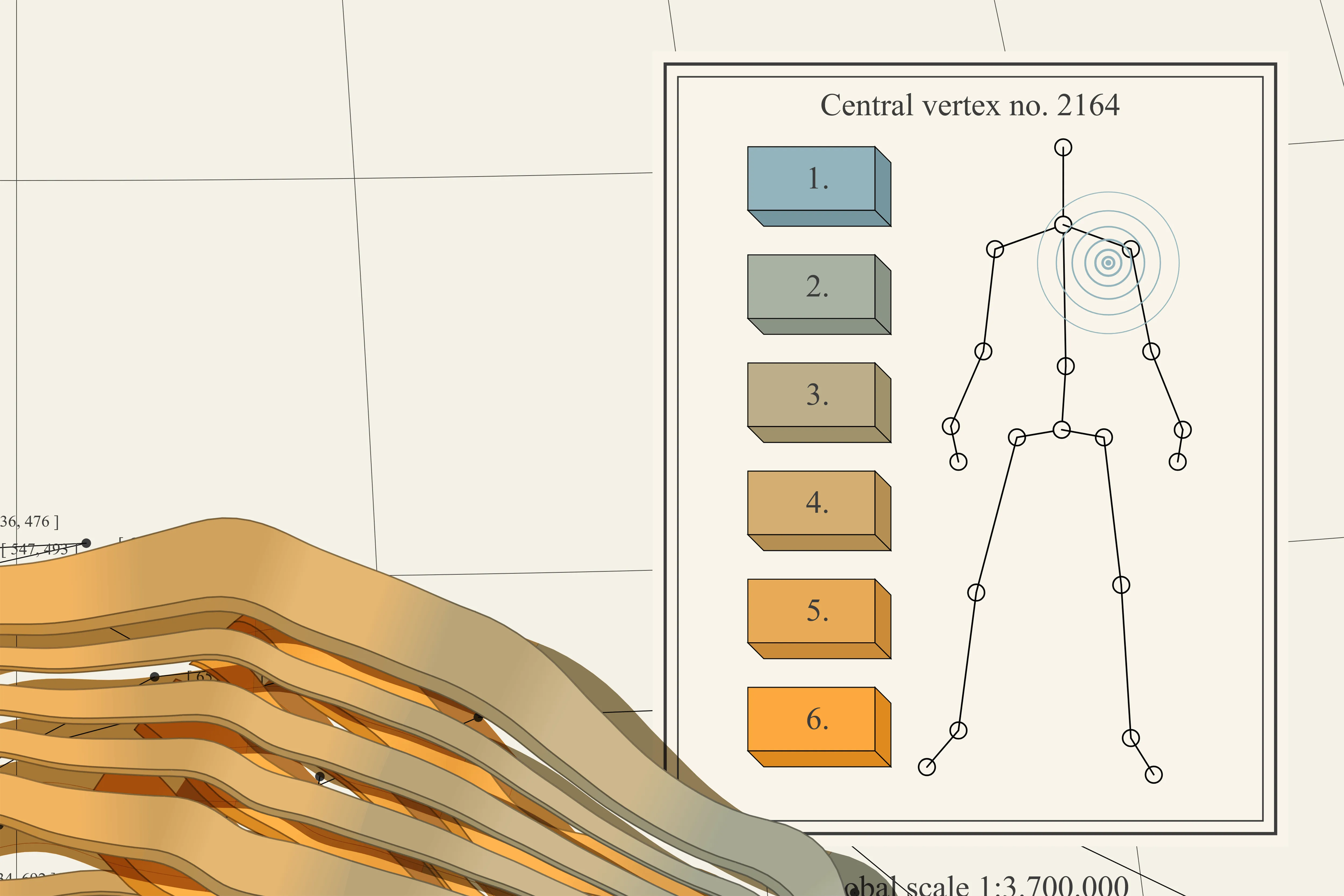
My intention was to build upon Juan’s work without making the visual reference too explicit or immediately recognizable. To achieve this, I chose to randomly frame only a portion of the vertex dataset, avoiding the visibility of the full human figure (dominant element in his practice) while still allowing observant viewers to recognize fragments of the body. I went back and forth when deciding how much of Juan’s original 3D structures should remain noticeable. At one point, I included the entire figure in the background, with a square overlay indicating the selected vertices. Eventually, I replaced this explanatory background "map legend" with my own stick figure, which can also be interpreted as a simplified rigging skeleton within a 3D model.
( 5 ) What did you keep and why?
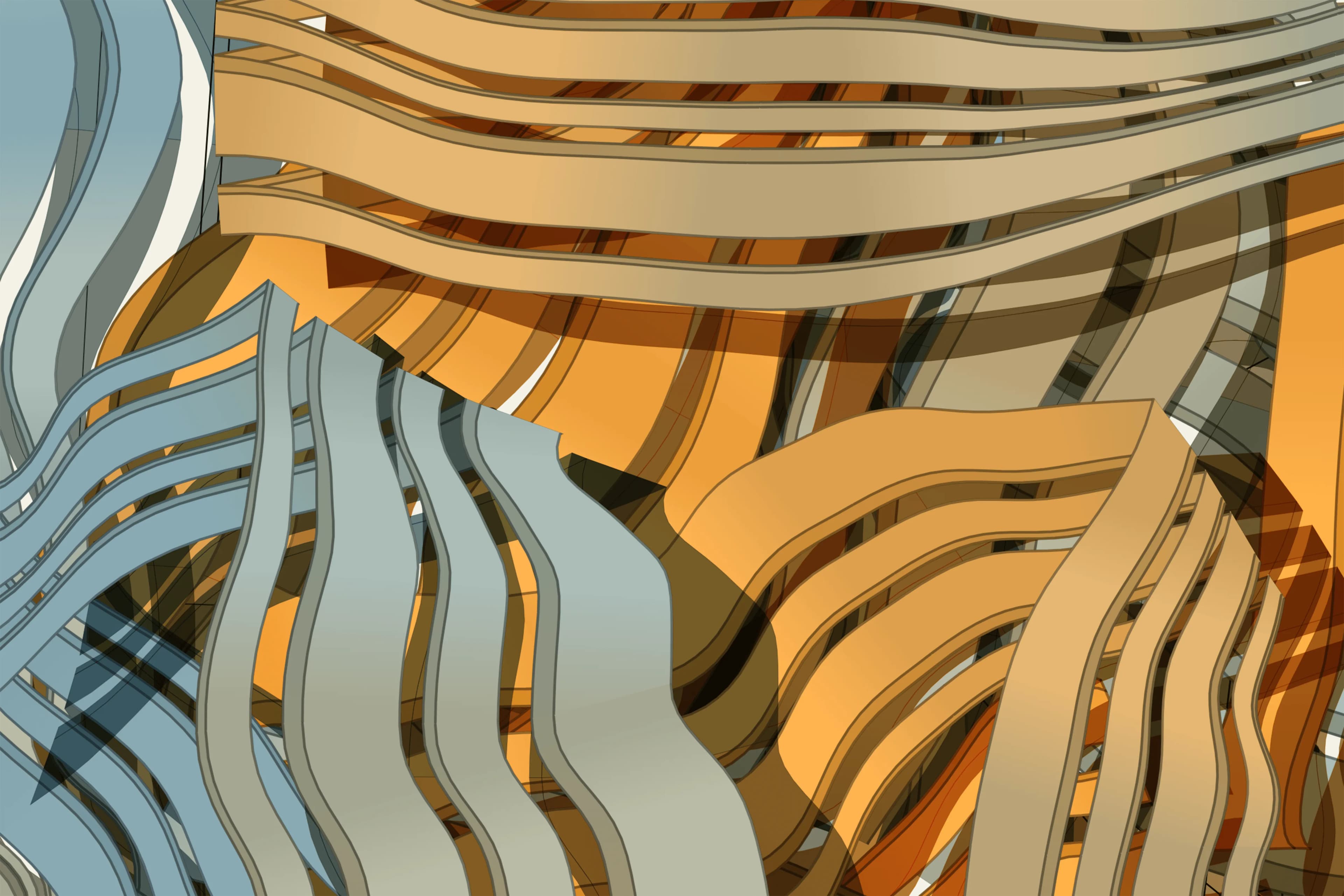
I kept what I consider one of the most recognizable elements in Juan’s work (the 3D human figure) along with the data that could be extracted from it, treating them as a flexible dataset that could function similarly to any set of random values. The resulting visuals allowed traces of the underlying structure to remain noticeable without becoming overly obvious. In this way, I aimed to respect the original artist’s work while extending it through my own style and techniques.
( 6 ) Anything Else?
The slight anxiety I felt while waiting for my turn quickly faded once I began working on the project. It became similar to being given an abstract topic or concept and exploring what I could contribute while maintaining a meaningful connection between the previous artist’s work and my own.
Aleksandra Jovanić is an artist and programmer from Belgrade, Serbia. She holds a doctorate in Digital Arts and a BSc in Computer Science. In her research and artistic practice she combines various media, mainly in the field of interactive art, art games, and generative art. Jovanić’s recent works focus on the aesthetic of data visualization and optical illusions, as well as explorations of accepted concepts of truth and reality.
Her work has been exhibited internationally in exhibitions at Unit London, Feral File, Vellum LA/Artsy, Galerie Data, ArtBlocks and ArtBasel with Tezos.
As an associate professor, she currently teaches at all three levels of study, at the Faculty of Fine Arts in Belgrade, at master studies of the Faculty of Applied Arts and at art doctoral studies at the University of Arts in Belgrade.